
Hamilton County Sex Offender Checks
The Florida Sexual Offender and Predator Registry is operated by the FDLE Offender Registry Services Bureau. Its quick search accepts a name or place. Advanced search adds legal designation and status filters. Neighborhood search works from an address and radius. Choose Hamilton in the county field for a countywide result set.
Prepare the person’s full or partial name, or an address, city, and ZIP for a map search. Compare aliases, birth date, physical description, and the listed address before assuming a profile refers to the intended person. FDLE warns that positive identification requires fingerprint comparison. The registry may change quickly as people report moves or status changes.
The official registry home interface shows its public search choices.
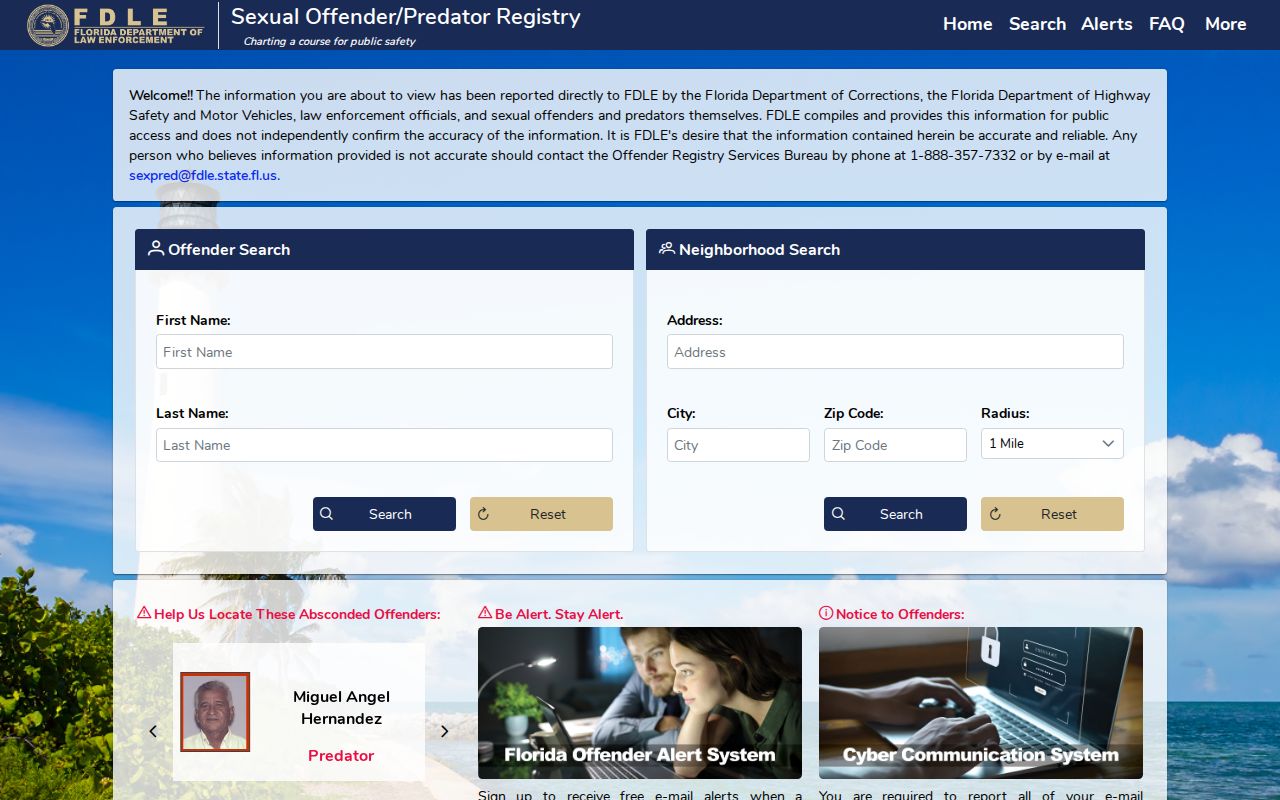
The search begins at the state level even when the question concerns a Hamilton County address.
Hamilton Registry Labels Are Not Tiers
Florida publicly labels a person as a sexual offender or a court-designated sexual predator. Those are statutory categories. They are not the three public SORNA risk tiers used in some other states, and the registry does not publish an actuarial risk score. A “predator” label reflects a legal designation under Florida law, not a personalized forecast produced by the website.
Status is a different field. Options include absconded, confined, deceased, deported, released and subject to registration, civil commitment, and supervision through FDC, DJJ, or U.S. Probation. Read designation and status separately. Neither field replaces the qualifying-offense and adjudication details in the full profile.
Florida Registry Searches
The advanced registry is free and requires no account. Use the least data needed to find a manageable list, then verify the profile details. Partial first or last names are allowed. A location search can start with city, county, or ZIP. Selecting Hamilton filters the county without implying that every listed address lies within an incorporated city.
- Open the FDLE registry and choose the name, neighborhood, or advanced search that matches the question.
- Enter a partial or full name, or choose Hamilton County and add a city or ZIP when useful.
- Review aliases, birth date, designation, status, and address to separate similar names.
- Open the full profile, read the qualifying offense and source dates, and use fingerprints for positive identity.
| Field label | Type | Required | Notes |
|---|---|---|---|
| First / Last Name | Text | One name or location field | Full or partial names permitted |
| City / ZIP Code | Text | One name or location field | Searches reported residence location |
| County | Dropdown | One name or location field | Select Hamilton from all 67 counties |
| Offender Type | Dropdown | No | Both, Offender, or Predator |
| Offender Status | Multi-select | No | Includes absconded, confined, released, and supervision choices |
| Thumbnails / Aliases | Checkboxes | No | Add result images or aliases |
| Neighborhood Radius | Map search | Address location | Quarter-mile through five-mile choices |
The FDLE advanced registry screen displays the detailed filters.
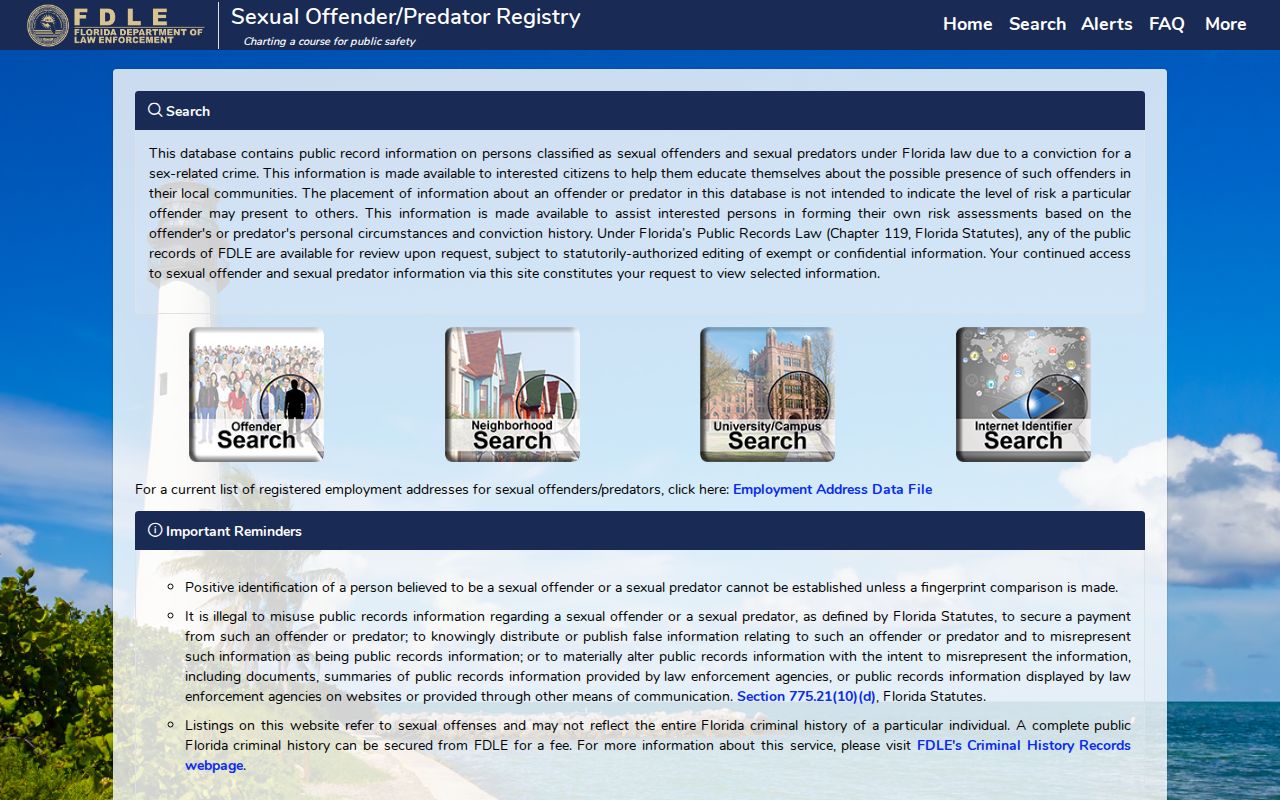
Its filter set supports a more precise Hamilton County lookup than a broad name alone.
Hamilton Neighborhood Search Distances
Neighborhood Search accepts an address, city, and ZIP, then maps reported locations within one-quarter, one-half, one, two, three, four, or five miles. One mile is the default. A small radius can answer a close-address question. A wider radius is more useful across Hamilton County’s rural roads, where homes and public places may be far apart.
A radius is a geometric filter, not a guarantee about a route, property line, or legal residence restriction. Map markers depend on the address information reported to FDLE and may change. Check the profile’s source and received dates. For cross-state searching, the U.S. Department of Justice’s NSOPW portal adds participating jurisdictions beyond Florida.
Registry Profiles: What They Show
An FDLE profile combines identifying details with registration and qualifying-offense data. It may also display vehicle, vessel, scar, mark, tattoo, map, flyer, and tracking information. Victim identity is not published. The profile may state victim gender and whether the victim was a minor.
| Name & Aliases | Reported name, aliases, date of birth, and linked identifiers such as an FDC number. |
|---|---|
| Photo & Description | Dated photograph, race, sex, hair, eyes, height, weight, scars, marks, and tattoos. |
| Registered Address | Full location, county, address type, source, received date, and map when available. |
| Offense & Statute | Description, statute, case number, jurisdiction, adjudication date, and adjudication. |
| Designation | Florida sexual offender or court-designated sexual predator, not a public risk tier. |
| Registration Status | Current public status such as released, supervised, confined, absconded, or deceased. |
“View Flyer” creates a printable summary, while “Track Offender” connects to notification tools. Printing is limited to 25 selected records at a time. A public CSV dataset is also available, but bulk data still carries the same identification and misuse limits.
Track Hamilton Moves With Alerts
The Florida Offender Alert System provides free email notification. A reader may track a particular person or receive notice when a registrant reports a move within a chosen distance of an address. Alerts supplement direct registry checks. They do not prove that no other relevant move or status change occurred.
The official alert enrollment page shows the state notification channel.
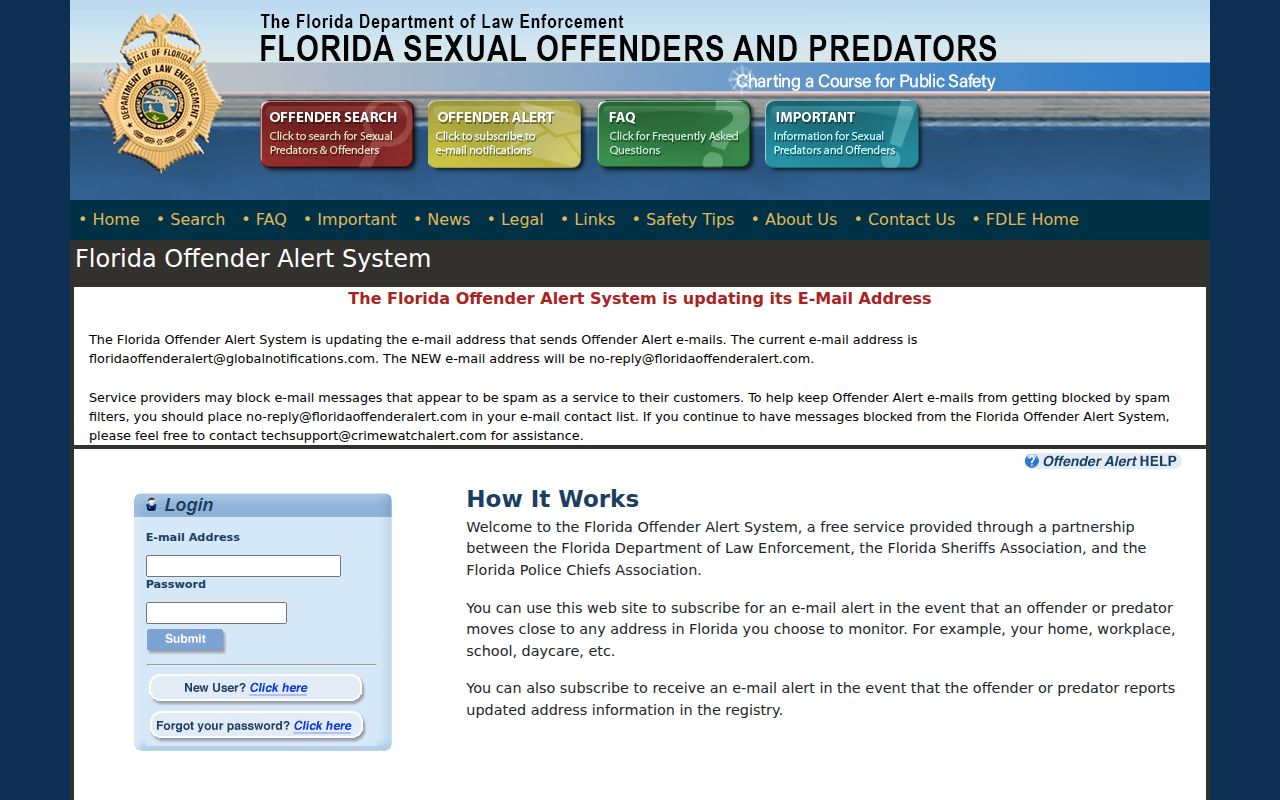
Enrollment turns a one-time Hamilton County registry search into notice of later reported changes.
Registration Levels and Duties in Florida
Florida registration is generally for life. The public system does not divide people into Tier I, II, and III. Reporting frequency depends on the governing offense and designation. Offenders generally report twice or four times each year, depending on the offense. Sexual predators ordinarily report quarterly. Each person must also report changes required by Florida law.
| Florida category | Duration | Verification frequency |
|---|---|---|
| Sexual offender, standard schedule | Generally lifetime | Generally twice yearly |
| Sexual offender, specified offense | Generally lifetime | Generally four times yearly |
| Sexual predator | Generally lifetime | Ordinarily quarterly |
Section 943.0435 contains a narrow petition route for some people after at least 25 years without arrest following release from sanctions. Excluded offenses and judicial findings apply. It is not automatic removal and should not be treated as a general 25-year end date.
Hamilton County Sheriff Registration
Hamilton County registration occurs through HCSO at 207 NE 1st Street in Jasper. Confirm the dedicated reporting day and time in FDLE’s current county location directory or call the sheriff at (386) 792-2004. General records-counter hours do not necessarily equal registration hours. FDLE’s Registry Bureau is also available at 1-888-357-7332 and sexpred@fdle.state.fl.us.
Registration information moves from the local reporting office to FDLE’s state system. A public user then searches the state registry rather than a separate Hamilton-only list. If an address appears wrong, report the concern to law enforcement or FDLE. Do not confront the listed person or household.
Florida Residence Rules in Hamilton
Florida Statutes §775.215 creates a 1,000-foot residence provision for specified convictions in relation to schools, child-care facilities, parks, and playgrounds, subject to the law’s dates and exceptions. It does not apply to every listed person in the same way. No additional Hamilton County ordinance was verified.
Do not use the neighborhood-search radius as a legal measurement tool. A registry map is for public awareness, while compliance depends on the statute, qualifying conviction, dates, property facts, and official enforcement review. Direct a suspected violation to HCSO or FDLE.
Florida registry laws:
Florida Statutes §943.0435 sets sexual-offender registration and reporting duties.
Florida Statutes §775.21 governs sexual-predator designation, notification, and registry misuse.
Florida Statutes §775.215 provides the state residence restriction for specified convictions.
Using Registry Information Lawfully
Registry information supports community awareness and personal or family safety planning. It does not establish a person’s complete criminal history, present conduct, or individualized risk. Check the profile’s dates and legal details, use alerts for reported changes, and contact law enforcement with a good-faith concern.
Florida law controls misuse. Section 775.21(10)(d) prohibits using registry information to secure payment, publishing false material as public-record information, or materially changing it to misrepresent the record. The violation is a first-degree misdemeanor. Harassment, threats, vigilantism, and confrontation are unsafe and improper.
Registry misuse is a crime: Florida Statutes §775.21(10)(d) makes specified misuse a first-degree misdemeanor. Report suspected noncompliance to law enforcement instead of confronting anyone.