
Hamilton County Criminal History Checks
No single Hamilton County database contains every report, booking, court filing, disposition, and statewide entry. Match the source to the task. The Hamilton Clerk’s Court Search gateway routes trial-court inquiries to CiviTek. The sheriff’s records staff handle sheriff-created reports and calls for service. FDLE supplies statewide repository responses, while FDC covers people in state prison or under state supervision.
Start with a full legal name and any known case, report, or booking number. Add an event date, location, and spelling variants when possible. A common name alone is not firm identification. Compare the court level, filing date, alleged offense, and case number before relying on a result.
- Define whether the need is a police report, booking, court case, statewide history, or corrections status.
- Search the matching official county or state channel with the most precise details available.
- Check the source agency and dates to separate people with similar names.
- Follow a booking charge into the clerk docket to see what prosecutors filed and how the court ruled.
- Request a certified clerk copy or fingerprint-based personal review when identity or official proof matters.
The official Hamilton Clerk home page shows where local court access begins.
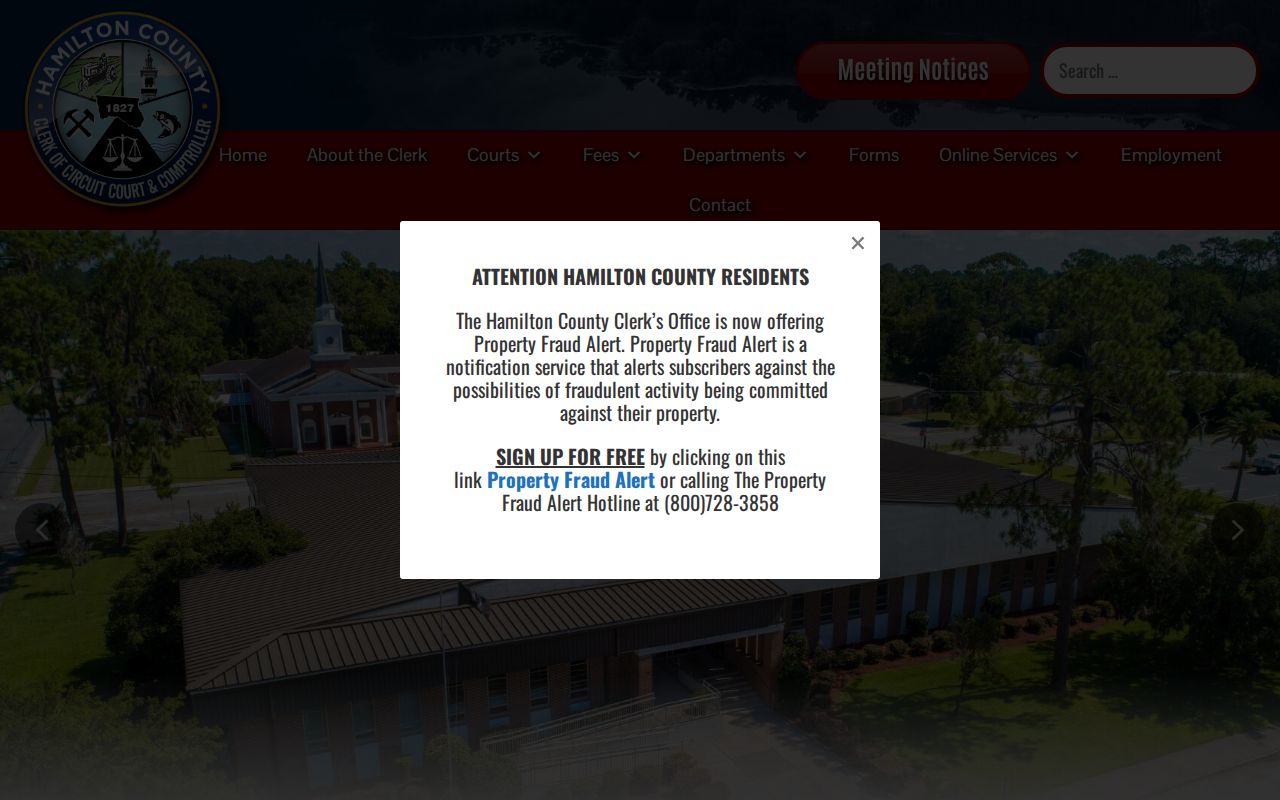
Its Records Search route is the local starting point for filed felony, misdemeanor, and criminal-traffic cases, not sheriff narratives or jail custody.
Hamilton County Records Share an Address
Hamilton County’s main records offices publish the same street location, 207 NE First Street in Jasper, yet they do not hold the same files. The Clerk of Circuit Court and Comptroller works from Room 106 and maintains court dockets, pleadings, judgments, sentences, and certified dispositions. The Hamilton County Sheriff’s Office publishes the same street address for law-enforcement records and jail functions.
Ask for the custodian, not merely the building. Clerk staff can help with a filed charge or final disposition. Sheriff staff can locate an HCSO incident report, arrest report, call for service, or booking material. Jasper Police Department remains a separate custodian for reports its officers created. The State Attorney prosecutes cases but is not the clerk’s docket office or the sheriff’s report desk.
Hamilton County Clerk
207 NE First Street, Room 106
Jasper, FL 32052
(386) 792-1288
Court files and certified dispositions
HCSO Public Records
207 NE 1st Street
Jasper, FL 32052
(386) 792-7102
Sheriff reports, calls, and booking copies
Jasper Police Records
recordsrequest@jasperfl.gov
(386) 792-1130
Reports created by Jasper officers
The Third Judicial Circuit’s Hamilton profile depicts the courthouse and identifies Hamilton as one of the circuit’s seven counties.
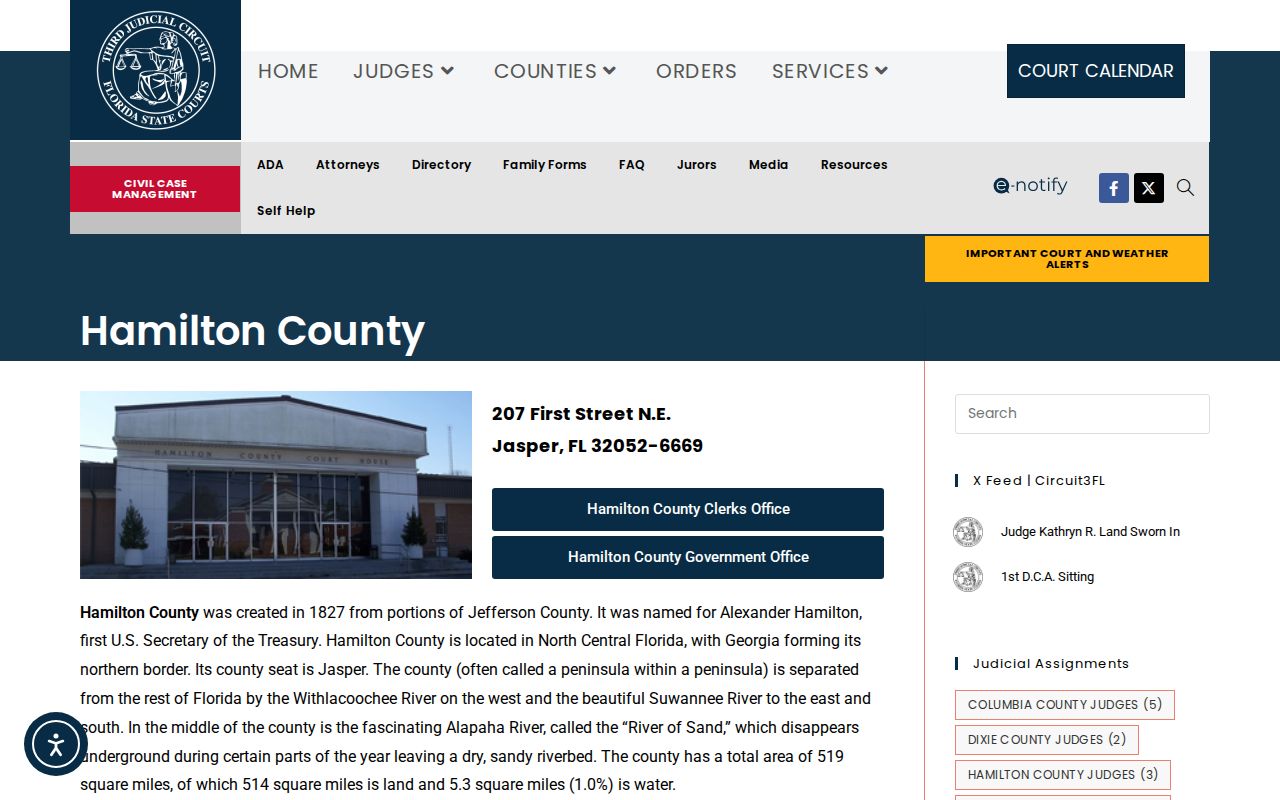
The shared site makes local access compact, but the correct counter still depends on who made and maintains the record.
Official Background Checks in Florida
The Florida Department of Law Enforcement Division of Criminal Justice Information Services is the state’s central repository. Its public Florida Criminal History Record Check costs $24 and offers Instant Search plus certified or non-certified electronic requests. Payment is by debit or credit card. This is a name-based search of information reported to FDLE, not fingerprint proof that a result belongs to a particular person.
For review of one’s own record, FDLE Personal Review uses fingerprints and supports correction of disputed data. Statutorily authorized state and national checks use an agency-supplied ORI and an FDLE-approved Livescan provider. No approved storefront was confirmed inside Hamilton County, so consult FDLE’s current provider list rather than assuming a local vendor.
| Official product | Cost and identity | Best use |
|---|---|---|
| FDLE public Florida check | $24; name based | Reported public repository history statewide |
| FDLE Personal Review | Fingerprint based; no FDLE fee located | Review and correct one’s own Florida record |
| Authorized Livescan check | ORI controls scope; vendor fee varies | Checks required by a specific Florida law or agency |
| FBI Identity History Summary | Fingerprint based; current federal fee applies | Subject-only federal self-review |
The FDLE Florida Checks page sets out the state’s official choices.
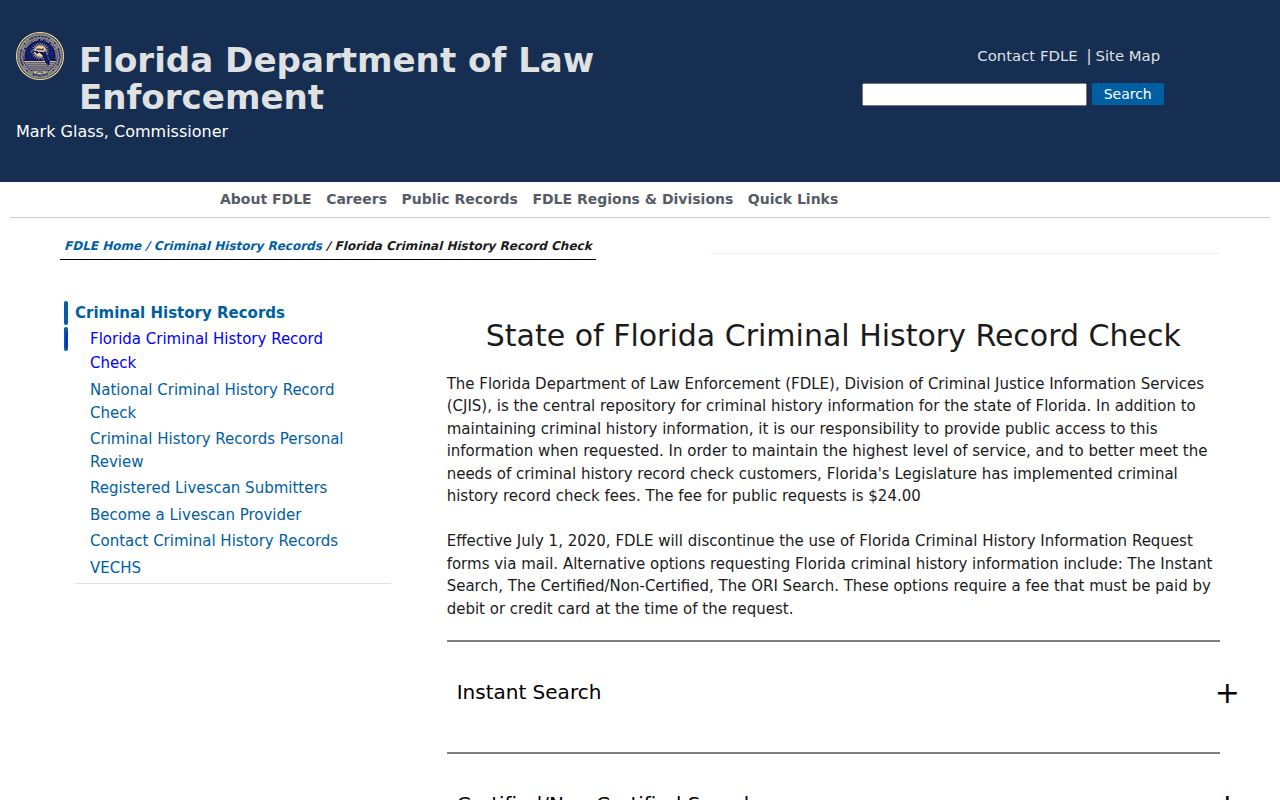
Its separate products matter because speed, certification, and positive identity are different needs.
Four Hamilton County Arrest Records
One arrest may create four distinct records. The arresting agency writes the event narrative and grounds for the arrest. Hamilton County Jail makes an intake record with booking identifiers, the charge presented at admission, bond, and release status. Prosecutors then decide what to file, and the Clerk maintains that court case. Fingerprint-supported data may also reach FDLE’s statewide repository.
Those records can disagree without any office making a false entry. An intake charge may change after review. A court may dismiss a count, accept a plea to another offense, or enter an acquittal. FDLE may not yet have the disposition. For a full sequence, compare the originating report, booking entry, clerk docket, and FDLE response.
A sheriff report explains the event, while a certified clerk disposition establishes what the court ultimately did. Neither should be replaced with an unofficial people-search result.
Kinds of Criminal Records
Hamilton County criminal records are grouped by purpose and custodian. Knowing the difference prevents a wasted request and keeps an initial allegation from being mistaken for a conviction.
- Incident and offense reports describe observations, allegations, witnesses, property, and investigative acts recorded by HCSO or Jasper PD.
- Arrest and booking records document custody and intake; they do not prove guilt.
- Court case files show filed charges, motions, hearings, pleas, judgments, and sentences.
- Warrant information concerns court-issued authority handled through law enforcement and the issuing case.
- Corrections and supervision records come from FDC after a qualifying state sentence or supervision order.
- Registry records show Florida’s statutory offender or predator registration data, not a complete criminal history.
Juvenile files follow special confidentiality rules. Most are not open through an ordinary public name search. Calls-for-service data also differ from a full narrative report, just as a jail record differs from a court judgment.
Hamilton County Jail View Fallbacks
HCSO labels its online custody endpoint “Jail View,” but the official address displayed a default Microsoft IIS page during research. A blank or broken screen does not show that a person is absent from custody. The direct fallback is Booking at (386) 792-7131. Visitation or current control rules go to (386) 792-7130, and copies of sheriff-held booking material go to Public Records at (386) 792-7102.
After a charge is filed, use the clerk docket for case status and disposition. FDC Offender Search serves a different population: people in Florida prison or under FDC supervision. It does not replace Hamilton County Jail View. Federal custody requires the BOP locator.
The official FDC Offender Search illustrates the state corrections layer.
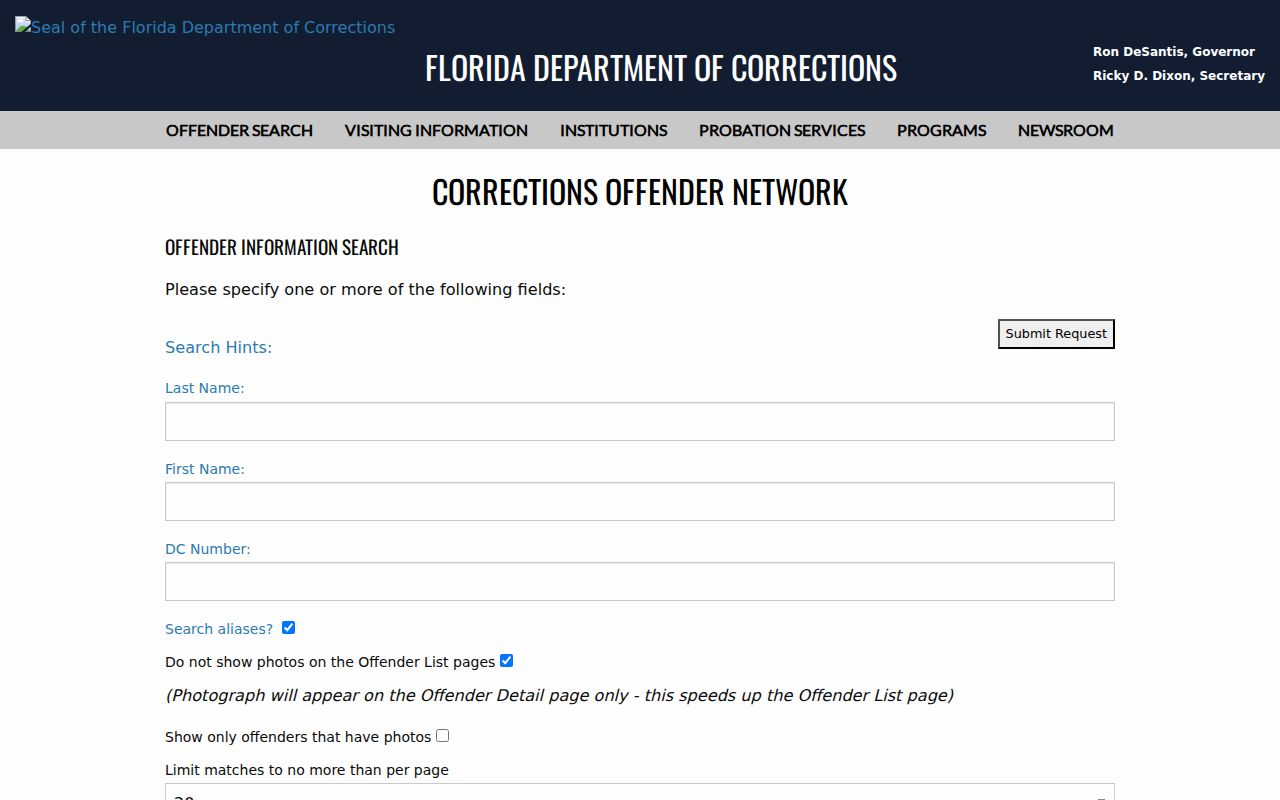
Use it for a state prisoner or supervised person, while current county intake questions remain with HCSO Booking.
Hamilton County Criminal Records: What They Contain
The visible fields depend on the source. An FDLE history may connect identity descriptors to fingerprint-supported arrest cycles, agencies, charges, and reported outcomes. A Hamilton clerk file is richer on litigation. A booking entry focuses on intake and custody.
| Name & Identifiers | Legal name, aliases, date of birth, and agency tracking identifiers when lawfully public. |
|---|---|
| Arrest / Booking Data | Arresting agency, intake date, booking number, initial charge, bond, and release information when available. |
| Charges & Statutes | Alleged offense and statute at arrest, followed by the charge prosecutors formally file. |
| Disposition | Dismissal, plea, trial result, adjudication, or other court outcome shown by the clerk. |
| Sentence | Custody, probation, financial obligations, and other terms imposed in the judgment. |
| Custody / Supervision | County jail status, FDC prison status, or state community supervision, depending on the system. |
Reporting delay, unmatched dispositions, confidentiality, and expunction or sealing can produce gaps. When reviewing one’s own history, compare certified Hamilton clerk documents with FDLE Personal Review and identify the contributing agency before seeking correction.
The FDLE Personal Review page describes that fingerprint-based self-review path.
Fingerprint identity makes this route more useful for resolving one’s own disputed entry than a public name result.
Hamilton County CiviTek Case Search
The clerk’s Court Search page leads to CiviTek Online Court Records Search. Read the local disclaimer, choose Hamilton from the county menu, and continue to the clerk system. The gateway was free and required no login during inspection. Only the county dropdown and Go button were verified because the downstream Hamilton form did not render.
| Verified field | Control | Use |
|---|---|---|
| County | Required dropdown | Select Hamilton from the participating county list |
| Go | Button | Open the selected clerk system |
Do not assume the portal supports date-of-birth searches, wildcard rules, downloads, or online certified copies. If it stalls, call the Clerk at (386) 792-1288 or ask at Room 106. Older, archived, unindexed, confidential, or restricted material may not appear online. The dedicated Hamilton County court case lookup explains filed charges and docket stages in more depth.
Florida Public Access Laws
Florida’s Constitution and chapter 119 begin with broad access to public records, but a public-records state does not expose every field. A custodian may redact exempt content while releasing the public remainder. Actual duplication cost may apply, plus a reasonable special-service charge when a request uses extensive staff or technology resources. Ask for an estimate before approving a large request.
Key Florida authorities:
Florida Statutes §119.07 sets inspection, copy, fee, exemption, and redaction duties for custodians.
Florida Statutes §943.053 governs FDLE criminal-history dissemination and related fees.
Florida Statutes §943.0585 governs court-ordered expunction and its limited disclosure effects.
Florida Statutes §943.059 governs sealing and access retained by specified agencies.
Florida Statutes §985.04 limits access to juvenile justice records.
Active investigative information, protected victim details, juvenile material, sealed matters, and personal identifiers may be withheld under specific law. If HCSO denies part of a request, ask for the statutory exemption. Remote court access may also be narrower than inspection at the clerk counter.
Hamilton County Warrant Verification
No verified comprehensive public warrant list was found for Hamilton County. Call HCSO Civil Process/Warrants at (386) 792-7101. After hours, Communications is (386) 792-1001. Public Records at (386) 792-7102 can address sheriff-held records, while a CiviTek docket may show a warrant event tied to a filed case. It is not a live countywide warrant system.
Failure to appear may lead to a warrant, bond forfeiture, and detention. Other warrants can arise from probable cause, a pending court case, or a search that remains sealed before execution. To resolve one’s own warrant concern, confirm the issuing court and case number, seek legal advice, and ask HCSO how surrender or bond must occur. The clerk cannot simply change a court date or clear law-enforcement status.
| Question | First Hamilton channel |
|---|---|
| Possible active warrant | HCSO Civil Process/Warrants, (386) 792-7101 |
| After-hours verification | HCSO Communications, (386) 792-1001 |
| Warrant event in a filed case | Hamilton Clerk/CiviTek |
| Copy of a sheriff-held record | HCSO Public Records, (386) 792-7102 |
Restricted, Sealed & Expunged Records
Florida distinguishes sealing from expunction. Sealing restricts public access while specified agencies retain access under statute. Expunction generally directs agencies to destroy or obliterate covered records, while FDLE keeps a confidential notation and limited authorized access. Neither occurs because a web result was removed or a case was dismissed.
The ordinary path begins with a certified disposition from the Hamilton Clerk. Next comes an FDLE Certificate of Eligibility, then the petition, affidavit, proposed order, service on the State Attorney and required agencies, and any hearing the court orders. The certificate does not grant relief or bind the judge. Hamilton’s clerk fee schedule lists $42 for sealing a court file or expungement of record, but research did not confirm that as the full case cost.
| Hamilton or Florida item | Published amount | Important limit |
|---|---|---|
| FDLE public name check | $24 | Repository response, not a certified local disposition |
| Clerk sealing/expungement service item | $42 | May not be the full filing and copy cost |
| Public-record copies | Actual duplication cost may apply | Extensive work can add a reasonable service charge |
| Livescan collection | Varies by provider | ORI and authorized purpose control the submission |
Serious excluded offenses, prior adjudications, and prior relief can affect eligibility. Juvenile diversion, human-trafficking-victim, and lawful-self-defense expunction use separate rules. Use the current FDLE packet and ask the Clerk for the present total, certified-copy cost, and filing procedure.
Hamilton County’s Fireproof Record Vault
Hamilton County was created in 1827, and its first courthouse was a log building at Micco. A brick courthouse rose on the present site in 1891. Fire partly destroyed it in 1928, forcing officials into the high school building and sending court sessions to a school auditorium or Masonic Lodge. The 1932 rebuild included a fireproof clerk office and vault.
That history explains why a modern portal should not be the final word on an older Hamilton County case. Archived material may need clerk research even when no online hit appears. Give staff a name, date range, court type, and any case reference rather than assuming the record was never created.
An official Florida Memory courthouse photograph preserves the earlier building context.
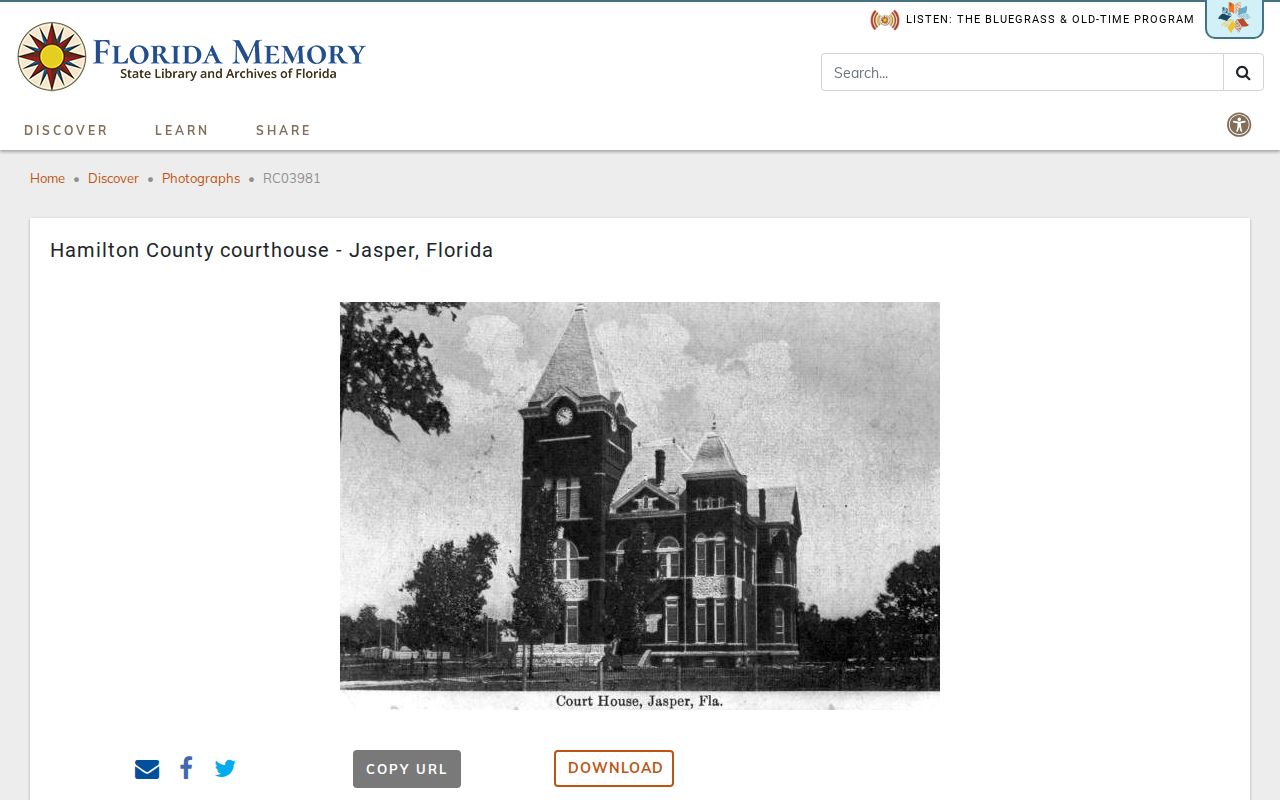
The image links today’s clerk records operation to a long paper-record history that predates online indexing.
Hamilton County Crime Data Context
Hamilton County crime claims need a clear year, source, measure, and population denominator. FDLE’s arrest dashboard counts reported charges associated with fingerprint bookings, not unique people convicted. Its date fields can also affect how an event lands in a filter. A charge count should never be described as a conviction count.
Jasper presents another local trap. The official 2024 estimate lists 4,008 people, including 1,467 inmates, and 2,541 when inmates are excluded. A per-capita rate can shift sharply depending on which figure is used. The 2020 Census counts used to rank Hamilton’s incorporated places are Jasper 3,621, Jennings 749, and White Springs 740. Raw totals do not by themselves establish risk or trend.
The Third Judicial Circuit State Attorney publishes the prosecution office’s regional role and selected case outcomes.
Those outcome releases can illustrate stages in a specific case, but they should not be turned into broad county crime-rate claims.
City-by-City Criminal Records in Hamilton County
Hamilton County’s three largest incorporated places use different first contacts. Jasper has a documented police records email. Jennings requires verification of the current originating agency before using county fallbacks. White Springs publishes HCSO as its law-enforcement service and keeps a separate Town Hall form for municipal documents. All three route filed criminal and traffic cases to the Hamilton Clerk.
Jasper Record Check
2020 Census: 3,621. Jasper PD keeps city-created reports; HCSO keeps county bookings.
Jennings Record Check
2020 Census: 749. Verify the current agency, then use HCSO and Clerk fallbacks.
White Springs Record Check
2020 Census: 740. HCSO serves law enforcement; Town Hall handles town documents.
City police and town records do not replace county booking or court files. Begin with the office that created the document, then follow the record to HCSO, the Clerk, or FDLE as the event moves through the system.